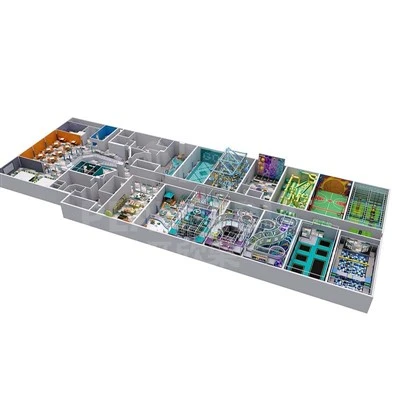
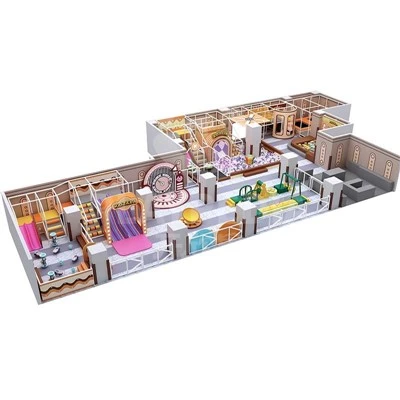
Indoor children's playground design and wholesale manufacturers are service providers specializing in the planning, design, equipment integration, and delivery of comprehensive solutions for children's play spaces. These manufacturers typically possess end-to-end capabilities-from conceptual planning to on-site construction-and provide customized children's playground solutions for commercial complexes, shopping centers, community facilities, and other venues. Understanding their core functions and industry characteristics helps industry professionals and investors make more informed project decisions.

The design and wholesale of indoor children's play centers is not merely a matter of purchasing equipment; it is a systematic process. The design phase requires comprehensive consideration of factors such as child psychology, spatial flow, color schemes, safety standards, and operational efficiency. The wholesale phase involves equipment selection, environmental standards for materials, modular production, and cost control. Excellent manufacturers integrate wholesale considerations into the design phase from the outset, ensuring that creative proposals are both manufacturable and cost-effective, thereby preventing discrepancies between blueprints and the final product.
From an industry perspective, the value provided by indoor children's play area design and wholesale manufacturers is primarily reflected in three aspects. First is professional design. Based on the behavioral characteristics of children in different age groups, designers plan reasonable play routes and divide the space into functional zones such as climbing areas, slides, ball pits, and role-playing areas. Second is standardized production. Prefabricated modular components manufactured in the factory shorten on-site construction time while ensuring product consistency and safety. Third is the ability to provide turnkey delivery. This includes one-stop services such as interior decoration, equipment installation, and soft furnishings, eliminating the need for investors to coordinate with multiple suppliers.

When selecting a wholesale manufacturer for indoor children's playground design, several key points deserve attention. First is the design team's comprehensive capabilities, including spatial planning, thematic creativity, and attention to detail. Second is the manufacturer's production and quality control system, which covers environmental certifications for materials and structural safety testing. Third is the diversity of past projects and the manufacturer's ability to adapt to different site conditions and investment budgets. It should be noted that there are no uniform industry-wide rating standards; investors should conduct on-site inspections of the manufacturer's production facilities and completed projects to obtain accurate information.
The specific collaboration process is typically divided into several stages. First comes the requirements discussion and site survey, during which the manufacturer proposes a preliminary conceptual design based on factors such as floor area, ceiling height, and entrance location. Next is the detailed design phase, which includes floor plans, renderings, construction drawings, and an equipment list. This is followed by the manufacturing phase, where various indoor playground facilities are custom-made according to the design drawings. Fourth is on-site installation and commissioning, which involves completing ancillary work such as soft furnishings, flooring, lighting, and sound systems. The entire process can take anywhere from several weeks to several months, depending on the project's complexity.
It is worth noting that there is a distinction between indoor playground design wholesalers and manufacturers that focus solely on play equipment. The former place greater emphasis on the overall spatial experience, incorporating thematic design, IP characters, and interactive technology to give the play center a unique identity; the latter primarily provide standardized equipment, which is better suited for simple venues with modest requirements. For investors seeking long-term operations, choosing a wholesaler with design capabilities often leads to a more differentiated competitive advantage.

From an industry trend perspective, safety and environmental protection remain the bottom line in indoor children's play center design. Modern manufacturers generally employ rounded corners, anti-pinch structures, and flame-retardant materials, while adhering to relevant national mandatory standards. At the same time, as parent-child consumption upgrades, immersive experiences, digital interactions, and age-segmented designs are receiving increasing attention. The wholesale sector is also gradually evolving toward flexible customization, supporting a production model characterized by small batches and a wide variety of products.
In summary, the core value of wholesale manufacturers specializing in commercial indoor playground lies in seamlessly integrating creative design with industrial production to provide investors with reliable, comprehensive solutions. Understanding the basic operational logic of this industry helps avoid common pitfalls and enables decision-making that better aligns with practical needs.