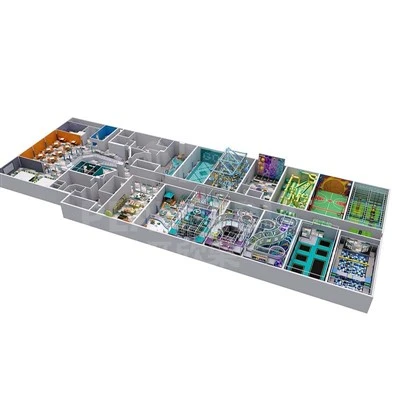
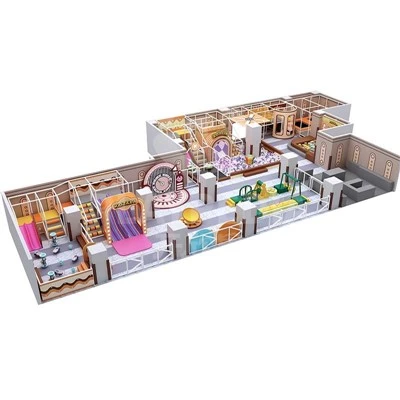
Step into a bustling indoor playground in the shopping mall. Soft-structured play centres, bouncy trampolines, fun interactive games and challenging ninja courses form a happy world for kids. Unlike large outdoor amusement rides, indoor play equipment focuses more on modular assembly, padded protection, low noise and adaptation to shopping mall ceiling heights. How are they built and how do they work? What structural and scientific principles support them? Today we will break down the design logic of indoor play equipment.
Classification and Features of Indoor Playground Equipment
Non-powered Structures
Including soft play centres, climbing nets, slides, ball pits and ninja obstacle courses. They rely on gravity and children's body weight for play. Hot-dip galvanized steel frames serve as load-bearing supports. All contact areas are fully covered with high-density foam padding and safety netting. Modular design allows flexible layout adjustment according to site dimensions. This is the most common category for indoor playgrounds.

Motorised Rotating Rides
Such as indoor merry-go-rounds and self-control planes. Motors drive rotating components with reducers for stable speed control. Running speed is gentle, suitable for parent-child and young children.
Elastic & Sliding Equipment
Trampolines, wave slides and spiral chutes. Trampolines use high-tension springs and jumping mats for energy buffering and rebound. Slides rely on gravity for smooth sliding. Designers carefully manage gradient and drop height to avoid high-speed impact.
Electronic Interactive Equipment
Laser shooting games, interactive projection, AR sand tables and arcade machines. They adopt optical sensors and signal recognition technology to realise human-machine interaction and create immersive play experiences.
Inflatable Equipment
Inflatable castles and inflatable obstacle runs. Continuous air supply from blowers maintains shape. Flexible fabric disperses impact force. They are easy to assemble and dismantle.
Five Core Structural Systems of Indoor Play Equipment
Main Load-bearing Frame
It is the foundation of the whole set of equipment, mostly made of hot-dip galvanized steel pipes, connected by welding or bolts in modular form. It bears all loads. Load calculation and deflection control are completed at the design stage to prevent deformation under long-term heavy use. All sharp edges and steel pipes are wrapped with protective padding.
Power and Transmission System
For motorised indoor play equipment, electric motors are the main power source. Frequency converters are used for speed adjustment and smooth start-stop. Common transmission types include belt drive, chain drive and gear drive. Some lifting and swinging rides are equipped with small pneumatic or hydraulic parts. Non-powered equipment needs no external power; gravity, elastic force and human movement drive the play action. This type takes the largest share in indoor playgrounds.
Electric Control System
It works as the brain of equipment. PLC programmable controllers and touch screens are widely used to manage start and stop, timing cycles, speed adjustment and sound-light linkage. Operators can control a single unit or link multiple devices together. Timing protection functions prevent risks caused by misoperation.
Safety Protection System (Key for Indoor Play)
Indoor areas usually have dense crowds and young children, so the protection system is highly prioritised. Mechanical safety parts include limit switches, brake locks and safety buckles. Electrical protection covers emergency stop buttons, leakage protection and overload power-off devices. Structurally, foam padding, safety nets, protective floor mats and ball pit layers absorb collision impact. The full protection system ensures fast shutdown and reduced injury when equipment malfunctions or users operate incorrectly.

Auxiliary Supporting System
It includes lighting, theme audio, ambient lights, special effects, safety signs and queue barriers. These elements build thematic atmosphere, guide visitor flow and separate different play zones to improve user experience while meeting shopping mall fire control and circulation requirements.
Closing
Understanding the structural principles of indoor playground equipment is more than learning the science behind fun. For playground investors and operators, it helps you evaluate layout plans, judge material quality and carry out routine inspection and maintenance, so safety and quality can be controlled from the very beginning.
Playpedia Amusement specialises in custom indoor family entertainment centres, soft play structures, ninja courses and trampoline parks. We comply with domestic standards as well as ASTM, EN1176 and other international safety specifications. With stable and reliable structural design, we deliver safe, durable and attractive play spaces for your venues. We look forward to cooperating with more partners to bring joy to families.