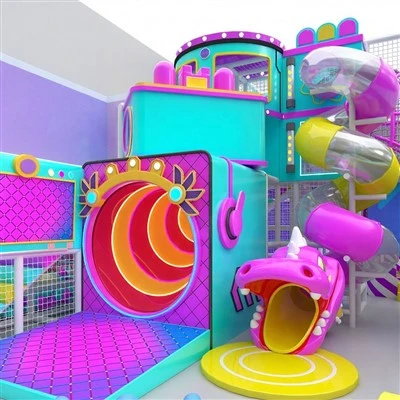
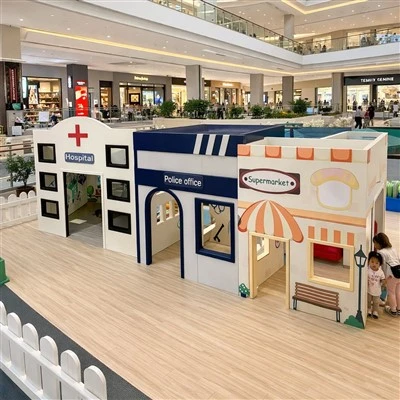
A durable, safe, and commercially viable indoor playground relies heavily on the selection of materials and anti-corrosion processes for its steel structure tubing and matching hardware. Many customers focus solely on appearance and price when purchasing, neglecting differences in tubing wall thickness, galvanizing processes, and the load-bearing capacity of cast iron fasteners. This can easily lead to safety hazards later on, such as rust, frame swaying, platform gaps, and structural deformation. Playpedia Amusement standardized steel structure system establishes complete anti-rust and load-bearing standards from tubing to all hardware.
I. Vertical Load-Bearing Steel Tubes: Hot-Dip Galvanizing Process + Graded Wall Thickness Standards

Low-cost indoor soft playground structures on the market typically use cold-galvanized thin-walled steel tubes with wall thicknesses of only 1.1–2 mm. The adhesion of the cold-galvanized coating is poor, and rust spots will appear within 3–6 months in humid indoor environments, significantly shortening the equipment's service life. Our play structures uniformly use hot-dip galvanized seamless steel pipes with an outer diameter of 48 mm. These are formed through a single-piece high-temperature zinc immersion process, ensuring a uniform zinc coating on both the inner and outer surfaces of the pipe walls. This provides long-lasting rust protection against water and moisture, making them suitable for humid environments such as shopping malls, residential communities, and early childhood education centers. Three grades of wall thickness are available based on specific requirements:
1. Standard small-to-medium-sized indoor play structures under 7 meters: Standard 2.5mm-thick hot-dip galvanized pipes, offering structural stability and moderate self-weight, with 4–7 spare columns included as standard;
2. Large, high-rise play structures over 7 meters in height: Upgraded to 2.75mm thick hot-dip galvanized tubing, offering superior tensile and bending strength to withstand high-altitude play loads;
3. We strictly reject 1.1–2mm cold-galvanized thin-walled tubing; such materials are not included in any standard supply configuration to eliminate the risk of rust and bending from the source.
Dimensional tolerances for platform frame tubing are strictly controlled; inner tubes are uniformly customized to a 117 cm specification and paired with 5 cm platform edging, perfectly matching standard122 × 244 mm wooden treads. Once assembled, the platform forms a seamless joint, eliminating gaps where children's feet or hands could get caught, ensuring both safety and aesthetics.
II. Complete Set of Steel and Cast Iron Fasteners: Graded Load-Bearing, Rust-Resistant Hardware System

The entire set of steel structure connection hardware undergoes anti-rust spray coating. Spare parts are provided with an 8%–10% surplus, and screw components include an additional 10% to facilitate replacement of parts lost during on-site installation. Fasteners are classified into three material grades based on load-bearing capacity:
1. Standard cast iron T-joint fasteners: Used for basic connections in small areas, suitable for conventional low-load assemblies;
2. Thickened heavy-duty cast iron fasteners: Load-bearing capacity increased by 150%–175%, suitable for high-traffic indoor play areas and connections between double-decker platforms;
3. LC-N25 cast steel high-strength fittings: With a load-bearing capacity 6–8 times that of standard cast iron, each node can withstand a tensile force of 3.5 metric tons. These are the preferred choice for high-rise structures, large slides, and sites in earthquake-prone areas, offering seismic resistance, stability, and resistance to loosening.
A comprehensive range of functional hardware covers all application scenarios: platform fasteners, window limiters, pipe floor mounting bases, suspension brackets for overhead obstacles, and pipe directional couplers. For sites in earthquake-prone areas, metal floor mounting flanges can be additionally installed to securely lock the frame in place and prevent shaking or displacement. All bent pipe fasteners undergo tensile testing before leaving the factory and are uniformly labeled with part numbers (A1/A2,B1/B2 sequence). Drawings specify the height of each upright column and the pipe numbers, allowing installers to quickly align and assemble components, thereby reducing on-site construction errors.
III. Standardized Production + Installation Quality Control Processes Ensure Rust-Proof Structures Are Properly Implemented
On the indoor soft play production side, the Engineering Department issues complete installation diagrams. The fabrication workshop strictly cuts materials according to the component list. Before packaging and shipment, the Quality Inspection Department conducts a secondary review of pipe wall thickness, galvanized coating thickness, and the quantity of hardware fittings, and re-verifies the parts list and loading configuration. Products with missing parts or substandard wall thickness are strictly prohibited from leaving the warehouse. Installation adheres to four mandatory standards: all fasteners must be properly aligned and tightened; pipe installation heights must exactly match the drawings; two numbered marking points are reserved on the top and bottom of each column; all bent pipes are tested before being filled with filler material; and after the entire steel structure is completed, the tightness of all screws is re-inspected to prevent loosening and wear over time, which could damage the galvanized anti-corrosion coating.

Commercial commercial indoor playground structures are children's play facilities subject to high-frequency use; rust protection and load-bearing capacity for the steel structure are by no means optional features.
Playpedia Amusement adheres to the standard of using a complete set of hot-dip galvanized tubing combined with high-load-bearing, rust-resistant hardware. We never compromise by substituting with thin-walled, cold-galvanized tubing. By employing standardized materials and processes, we extend the equipment's service life, reduce long-term maintenance costs, and provide venues with a long-term, stable, and safe play structure framework.