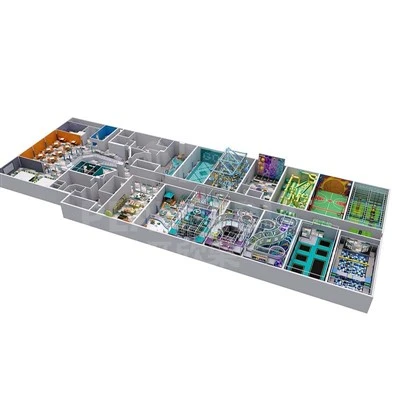
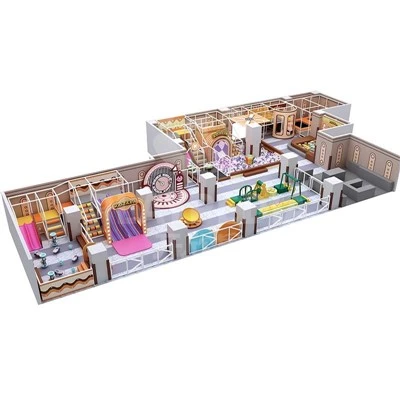
With the upgrading of family leisure demands and the diversification of commercial complexes, indoor playgrounds have become a highly promising investment sector.
Whether targeting parent-kid indoor playgrounds or teen-focused indoor adventure & interactive playgrounds, a scientific planning process is the core prerequisite for project success.
From initial positioning to operational implementation, building an indoor playground must adhere to three core principles: safety, fun, and compliance. This article breaks down five critical steps from design to installation, offering practical guidance for industry professionals. With our extensive experience, we help you plan more wisely and avoid costly mistakes.
Step 1: Precise Positioning and Site Assessment-Laying the Foundation
To get your project off the ground, start with two key tasks: finalizing its market positioning and conducting a full site evaluation. These two steps will guide all your subsequent design and equipment decisions.
The positioning phase focuses on two core elements: First, the target audience-clearly defining whether the facility serves infants (0-3 years), school-age children (4-8 years), or adolescents (9-14 years), as each group has distinct requirements for equipment difficulty and safety levels.
Second, the project theme-aligning with market trends to select styles like nature exploration, sci-fi space, or fairy tale IPs to enhance scene appeal and competitive differentiation.
Site assessment calls for concrete quantitative checks.
First, confirm the space area, ceiling height, and load-bearing capacity to ensure they match the target facilities-for example, aerial adventure rope courses need 3-5 meters of ceiling height, while large combination slides require enough buffer space.
Second, check floor flatness, electrical setups, and ventilation systems: motorized equipment needs stable power supply, and damp environments require advance moisture-proof treatment.
Finally, verify compliance key points like fire lane width (no less than 1.2 meters) and emergency exit locations to avoid rework risks later.
Step 2: Scientific Zoning and Traffic Flow Design to Optimize
Experience and Operations
Smart spatial planning is the key to upgrading play experiences and operational efficiency, with three core rules: clear zoning, separation of active and quiet zones, and smooth traffic flow.
Functional zoning must stick to age-based principles:
Toddler zones: Focus on soft climbing structures and sensory ball pits, fitted with 3cm-thick impact-resistant flooring and padded wall protection for all areas under 1.2 meters.
School-age zones: Combine physical challenge zones, role-playing corners, and educational game areas in one space.
Teen zones: Cater to high-energy activities like rock climbing walls, VR interactive games, and team competitions.
Support services are a must-have: set up parent lounges (with sofas, charging ports, and monitored viewing spots), nursing rooms (fitted with changing tables and outlets for bottle warmers), ticketing counters, and maintenance rooms. These spaces will boost family comfort and make daily operations run smoother.
Traffic flow should follow a single-loop route: Entrance → Toddler Zone → School-Age Zone → Teen Zone → Rest Area → Exit. Use clear floor markings to guide visitors, preventing route crossings and congestion. Adding dedicated express lanes for peak hours will also help increase the venue's capacity.
Step 3: Safety-Focused Design – Balancing Fun and Compliance
We stick to one core rule: Safety First, Fun a Close Second – and weave safety standards into every part of the design.
Materials must meet strict authoritative standards like EU EN71 and China GB6675. Prioritize non-toxic, eco-friendly options: food-grade HDPE plastic, E0-certified eco panels, and lead-free paint are all good choices. For high-energy play zones, lay 3–5cm thick EPDM rubber flooring (with impact absorption of at least 55%); for climbing areas, use anti-slip materials with a friction coefficient of ≥0.8.
Facility design needs to include these key safety details: round off all edges and corners to a radius of ≥15cm to get rid of sharp bumps; keep equipment gaps under 10mm to avoid finger-pinching risks; limit slide inclines to ≤30°; and fit all elevated structures with safety nets, automatic protection devices, and other necessary safeguards.
At the same time, add edutainment elements to boost the project's competitiveness – think STEAM-based interactive installations like AR sandpit adventures and wall projection painting. Once the design is finalized, draft a fire evacuation plan right away, making sure emergency exits, fire extinguishers, smoke detectors, and other safety gear all meet fire code requirements.
Step 4: Precise Equipment Selection and Supplier Screening to Ensure Quality Control
Equipment serves as the core foundation of theme indoor playgrounds .
Indoor playground equipment selection must balance three core factors: alignment with venue positioning, strict quality control, and cost-effectiveness.
The selection criteria should be tailored to the target demographics:
Toddler zones should prioritize soft, low-speed equipment including rainbow tunnels and musical piano mats.
School-age zones can be equipped with mini trampolines, balance beams, and large-block building sets.
Teen zones are suited for specialized facilities such as climbing walls and low-altitude rope challenge courses.
In addition, modular equipment is recommended for its flexibility-it facilitates future upgrades and reduces renovation costs.
Supplier screening is critical to ensuring product quality, and should cover these key aspects:
Verify supplier qualifications and confirm that products comply with international safety certifications (e.g., EN1176) and are supported by complete quality inspection reports.
Assess production capacity and delivery schedules to guarantee timely project completion.
Evaluate after-sales service systems, ensuring the provision of professional installation guidance, regular maintenance services, and sufficient spare parts supply.
For cross-border procurement, an additional check is required: confirm that equipment parameters meet the import standards of the target market to prevent potential trade barrier risks.
Step 5: Standardized Installation and Acceptance for Safe Operation Implementation
Proper installation and rigorous acceptance serve as the final safeguard for facility safety. Follow the principles of "professional operation, step-by-step implementation, and comprehensive testing." Pre-installation preparations include: leveling the ground, debugging power lines, and burying electrical conduits for motorized equipment 10cm underground to prevent child access. Install protective barriers around large equipment installation areas to prevent construction accidents.
Installation must strictly follow manufacturer guidelines: Secure large equipment with anchor bolts or welding to ensure structural stability. Apply anti-slip treatments to small equipment, and have electrical connections performed by licensed electricians to prevent short circuits and leakage risks. Acceptance involves dual testing: First, conduct no-load tests to verify smooth operation and identify issues like abnormal noise or shaking. Second, perform load tests simulating actual usage to validate load-bearing capacity and protective effectiveness.
Additionally, prominently display safety warnings, usage instructions, and age restriction signage. Complete debugging of emergency broadcast and lighting systems to ensure compliance with operational requirements.
Conclusion: Long-Term Operational Thinking Throughout the Process
The planning and installation of indoor playgrounds are not isolated steps; they require integrating long-term operational thinking from the outset. Designing with indoor playground equipment maintenance space, conducting thorough technical briefings during installation, and establishing a regular inspection system (at least one comprehensive weekly check) after acceptance are essential to ensure the project's long-term stable operation. As industry competition intensifies, only by integrating safety compliance, experience upgrades, and operational efficiency throughout every stage-from design to installation-can customized indoor playground projects achieve both market appeal and investment value. For international trade professionals, accurately understanding diverse market safety standards and consumer preferences further enhances a project's global competitiveness.
Learn more about our indoor playground.