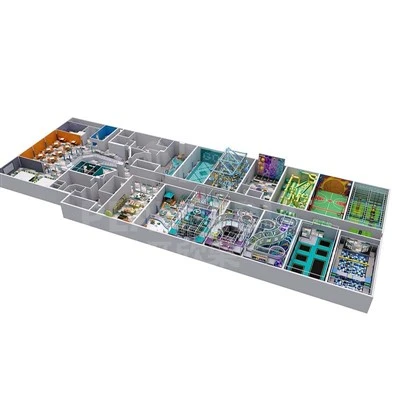
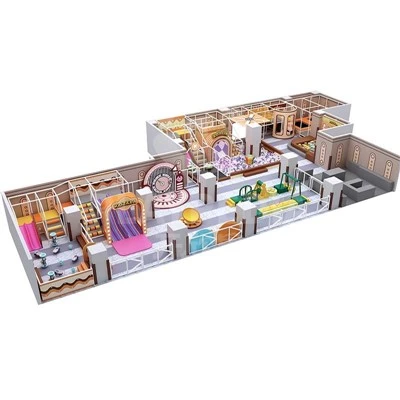
A new trend in the indoor amusement industry has become clear. More and more entrepreneurs are turning away from high-investment, high-risk large-scale amusement parks in shopping malls and are instead setting their sights on the community market. Leveraging the benefits of urban 15-minute convenience zones, asset-light, low-investment micro indoor amusement parks are rapidly rising to prominence, becoming a new hotspot for parent-child business ventures. Without the need for large floor space, these venues can cultivate a highly loyal customer base through meticulously designed play areas and sophisticated membership management, enabling a sustainable business model characterized by low costs, steady repeat business, and rapid return on investment.

The traditional indoor soft playground sector has long been saturated. Large-scale amusement parks in commercial complexes often require investments in the millions, compounded by high commercial rent, labor costs, and operational expenses-making the barrier to entry extremely high. Additionally, these venues primarily attract transient, walk-in customers, resulting in high unpredictability and low repeat purchase rates. They are highly susceptible to market fluctuations and seasonal lulls in foot traffic, leading to extremely poor operational stability.
However, parents' needs for children's entertainment have evolved, with proximity, safety, convenience, and frequent visits becoming core priorities. Play facilities in older neighborhoods are rudimentary and lack adequate safety measures, while commercial district playgrounds are distant and involve high per-visit costs. There is a severe shortage of high-quality indoor play spaces right on people's doorsteps, which continues to widen the market gap for community-based micro indoor playgrounds.
Low barriers to entry and a light-asset model are the core competitive advantages of micro indoor playgrounds. Unlike traditional, capital-intensive amusement projects, they can be established in community ground-floor retail spaces, residential building mezzanines, or small street-front shops ranging from 30 to 150 square meters, without requiring large-scale structural renovations. Playpedia Amusement employs a modular, non-powered equipment solution, eliminating redundant, non-standard customization to reduce upfront investment from the outset. Rent is only one-third of that for stores in commercial districts, and daily operations can be managed by a single person, significantly reducing fixed operating costs such as rent and labor. With controllable overall investment and extremely low risk, novice entrepreneurs, retail store owners, and those entering from other industries can all easily manage the business. Additionally, the equipment uses eco-friendly, maintenance-free soft-padded materials that are wear-resistant, safe, and easy to maintain, substantially reducing long-term upkeep expenses and continuously optimizing operating cash flow.

Many entrepreneurs hold the misconception that a small space equals low returns. In fact, the key to profitability in community-based micro-play centers has never been attracting crowds through large spaces, but rather achieving high space efficiency and stable profits through a combination of repeat customer business and high-engagement membership programs. We've specifically optimized layouts for small spaces by ingeniously utilizing vertical layering to create diverse zones-such as soft play areas for toddlers, interactive educational zones, and small-scale fun play areas-paired with a scientifically designed circular flow path. This approach accommodates multiple needs-play, supervision, and relaxation-ensuring maximum utilization of limited space while offering a variety of activities that rival those of larger venues.
What truly sets our stores apart is our refined membership management system. We reject the industry's crude prepaid schemes and have built a full-cycle, high-value membership service system tailored to different families' visit frequencies, offering diverse packages such as session passes, monthly passes, quarterly passes, and family annual passes. At the same time, we provide exclusive member benefits, including complimentary sessions, holiday-themed parties, parent-child DIY crafts, and points redemption, to continuously enhance user experience and a sense of belonging.
Leveraging the advantages of our community-based private domain, we conduct regular community group operations to share practical parenting tips, post event updates, and organize parent-child interactive games. This transforms a simple play area into a dedicated space for neighborhood moms to socialize and for parents to spend quality time with their children. A stable base of regular community patrons allows stores to completely eliminate the impact of seasonal fluctuations. At established locations, member repurchase rates remain consistently high, generating a sustainable and stable cash flow. Furthermore, stores can collaborate with local maternity and baby stores, daycare centers, and picture book libraries through cross-industry partnerships to expand diverse revenue streams and further increase profit margins.

As the development of child-friendly communities continues to advance, embedded community-based micro-play spaces have become an essential part of local infrastructure, with industry growth potential continuing to expand. Compared to large-scale amusement parks in commercial districts-where competition is fierce-community-based micro-indoor playgrounds face less competitive pressure, have strong demand, and offer quick return on investment, making them an excellent entrepreneurial choice in today's parent-child market.
Playpedia Amusement specializes in turnkey customization for community-based commercial indoor playgrounds, focusing on asset-light implementation solutions that balance safety, quality, aesthetic appeal, and cost control. It also provides a comprehensive support system covering membership management, event planning, and on-site implementation assistance. There's no need to invest heavily in prime commercial locations or worry about unstable foot traffic; even small spaces can effectively cultivate a dedicated customer base, retain members, and securely capitalize on this emerging trend in parent-child entertainment.