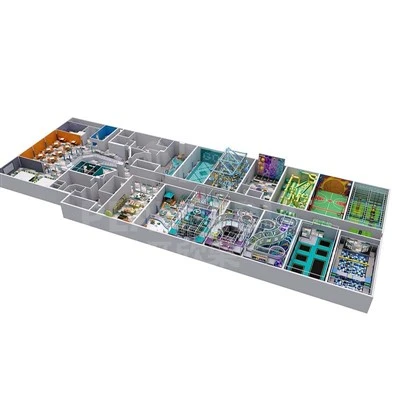
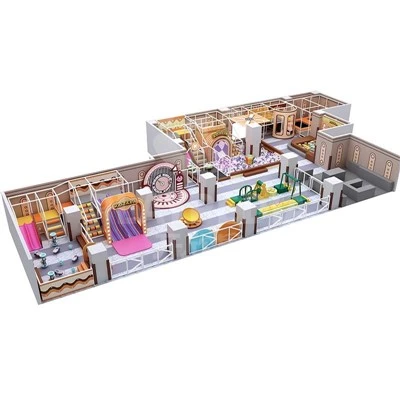
"Playing with their children" is often the only reason many parents visit indoor playgrounds-they find a corner to sit in near the entrance to the soft play area, look down at their phones, and occasionally glance up to make sure their children are still within sight. This is practically a standard scene at the vast majority of children's play centers today. But "accompanying" does not equal "participating." When equipment is designed solely for children, parents' role is limited to that of "supervisors" rather than "players."
The fundamental distinction between indoor play equipment for adults and that for children stems precisely from this difference in role. It is not merely a physical change-such as scaling up the size or darkening the colors-but a complete reconfiguration of the logic behind the experience.
The underlying logic of indoor children's equipment is protection and early learning. From the national safety standard GB/T 28489 to padded edges, finger-pinch-proof gaps, and eco-friendly, non-toxic materials, every design element revolves around "preventing injury" and "learning through play." Slides, ball pits, and climbing nets are intended to develop children's sensory integration and cognitive skills; their height is limited, their speed is controlled, and soft materials are the top priority.
In contrast, the underlying logic of adult attractions is liberation and immersion. When adults enter an indoor amusement park, they seek not the sense of being "protected," but rather the sense of conquest that comes from being "challenged" and the stress relief of a "temporary escape from reality." Therefore, adult attractions heavily incorporate IP storytelling, intense competition, and high-fidelity technology.


This difference in logic directly dictates the segmentation of operational spaces. In well-designed indoor amusement parks, age-based zoning is key to maximizing revenue per square foot. Areas for young children prioritize visibility for parents, while zones for teenagers and adults emphasize independent pathways and a sense of privacy. For example, high-thrill VR competition zones, escape rooms, or simulated racing areas are placed deep within the park or in separate compartments to prevent screams from interfering with the laughter in the children's areas, while also providing adults with an undisturbed space to enter a state of "flow."
Looking deeper, the development of adult attractions is shifting toward "mild thrills" and "social currency." The "extreme" experience here doesn't refer to roller coasters, but rather to the sensation of dizzying speeds-such as downhill skiing or aerial combat-that players can experience in a safe environment through precisely controlled motion platforms and 5D effects. These attractions often feature real-time scoring and leader boards or photo-sharing functions-adults spend money here to post a cool animated photo on their social media feeds or to enjoy the sense of accomplishment after competing against friends.
Therefore, when planning an indoor entertainment space that caters to both adults and children, the children's area follows a "hardware mindset"-purchasing high-quality slides, installing soft padding, and ensuring plenty of rounded corners; the adult area, on the other hand, follows a "software mindset"-selecting the right IP licenses, updating the game library, and fine-tuning the precision of equipment and lighting effects. Children's attractions are about building "trust," while adult attractions are about creating an "addictive experience." If we overlook this distinction and try to please adults with oversized versions of children's play equipment, the result is often that neither group is satisfied-adults find it childish, while children find it boring.

By breaking free from the old script of "adults accompanying children," adult recreational equipment isn't selling the equipment itself, but rather an "experience ticket" to a virtual world. This is the fundamental difference that sets it apart from children's indoor playground equipment.