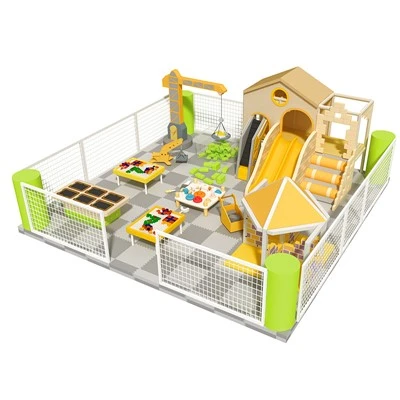
In today's fast - paced and technology - driven world, parents are constantly on the lookout for ways to enhance their children's development. One significant area of focus is helping kids develop problem - solving skills, which are crucial for their future academic, social, and professional success. An Indoor Play House emerges as a powerful tool in achieving this goal, and as an Indoor Play House supplier, I have witnessed firsthand the positive impacts these play spaces can have on children.
Understanding Problem - Solving Skills in Children
Problem - solving skills in children encompass the ability to identify problems, think critically about solutions, and implement those solutions effectively. These skills start developing at a very young age and are honed through various experiences. According to research in child psychology, children learn best through play, as it allows them to explore, experiment, and make sense of the world around them in a safe and enjoyable environment (Piaget, 1962).
An indoor play house provides a rich and stimulating environment that encourages children to engage in different types of play, each of which plays a unique role in problem - solving development.
Pretend Play and Problem - Solving
Pretend play is one of the most common forms of play in an indoor play house. Children often transform the play house into a variety of settings, such as a grocery store, a hospital, or a pirate ship. In these imaginary scenarios, kids are faced with a variety of problems that they must solve.
For example, if they are pretending to run a grocery store, they might encounter issues such as running out of stock, dealing with a difficult customer, or managing their budget. To solve these problems, children need to use their creativity and logical thinking. They might come up with strategies to restock the shelves, find ways to calm the customer, or calculate how to make the most of their limited funds. This type of play helps children develop social problem - solving skills, as they must interact with their playmates and negotiate solutions.
Moreover, pretend play also enhances children's cognitive flexibility. They can switch between different roles and scenarios, adapting to new rules and challenges. For instance, a child who plays the role of a doctor in the morning may become a chef in the afternoon, each role presenting its own set of problems to solve. This constant mental flexibility is essential for effective problem - solving in real - life situations.
Physical Play and Problem - Solving
Physical play in an indoor play house, which often involves climbing, crawling, and navigating through different structures, also contributes significantly to problem - solving skills. Structures like the Soft Play Bridge provide children with physical challenges that require them to think on their feet.
When a child attempts to cross a soft play bridge, they need to analyze the structure, understand its stability, and plan their movements accordingly. If the bridge is wobbly, they might need to adjust their balance and find ways to distribute their weight evenly. This process of assessing the situation, formulating a plan, and executing it is a classic example of problem - solving.
In addition, physical play helps children develop spatial awareness, which is another important aspect of problem - solving. By moving around the play house, children learn about distances, sizes, and shapes. They understand how objects fit together in space, which can be applied to solving puzzles, building structures, or even navigating through a crowded room in real life.
Cooperative Play and Problem - Solving
Most indoor play houses are designed to accommodate multiple children, which promotes cooperative play. When children play together, they are presented with a host of social problems that they must solve as a team.
For example, if a group of children wants to build a large fort using the Soft Play blocks in the play house, they need to communicate effectively, divide the tasks, and make decisions together. They might face disputes over the design of the fort or the distribution of materials, and they must learn to resolve these conflicts in a peaceful and fair manner.
Cooperative play also teaches children the value of compromise and collaboration. They understand that in order to achieve a common goal, they may need to give up some of their individual preferences and work towards a mutually beneficial solution. This is an important life skill that will serve them well in their future relationships and professional endeavors.
Sensory Play and Problem - Solving
Indoor play houses often incorporate elements of sensory play, such as textured materials, different sounds, and various scents. Sensory play engages children's senses and helps them make connections between different stimuli, which is fundamental to problem - solving.
When children explore a sensory area in the play house, they may encounter problems related to identifying and categorizing different sensory experiences. For example, they might need to distinguish between different types of textures or match sounds to their corresponding objects. This process of sensory discrimination and categorization helps children develop their observation skills and their ability to analyze information.
Furthermore, sensory play can stimulate creativity and imagination, which are essential for coming up with innovative solutions to problems. The diverse sensory experiences in the play house can inspire children to think outside the box and approach problems from different perspectives.
Long - Term Benefits of Problem - Solving Development in an Indoor Play House
Developing problem - solving skills in an indoor play house has far - reaching benefits for children. In the short term, it can improve their academic performance, as these skills are directly applicable to many school subjects, such as math, science, and language arts. Children who are good problem - solvers are more likely to be engaged in class, ask questions, and seek solutions independently.
In the long term, strong problem - solving skills are essential for success in the workplace. In today's competitive job market, employers value employees who can think critically, adapt to new situations, and solve complex problems. By providing children with a rich play environment where they can develop these skills from a young age, we are setting them up for a lifetime of success.
Conclusion and Call to Action
As an Indoor Play House supplier, I am passionate about providing high - quality play spaces that can significantly contribute to children's development. The impact of an indoor play house on problem - solving skills in kids is undeniable. Through pretend play, physical play, cooperative play, and sensory play, children are given the opportunity to develop and refine these essential skills in a fun and engaging way.
If you are a parent, educator, or facility owner interested in providing a play environment that fosters problem - solving skills in children, I encourage you to explore our range of Indoor Play House products. We are committed to offering innovative and safe play solutions that will inspire and challenge children. Please reach out to us for more information and to discuss your specific needs. We look forward to helping you create a play space that will have a lasting positive impact on the children in your care.


References
Piaget, J. (1962). Play, Dreams and Imitation in Childhood. W. W. Norton & Company.