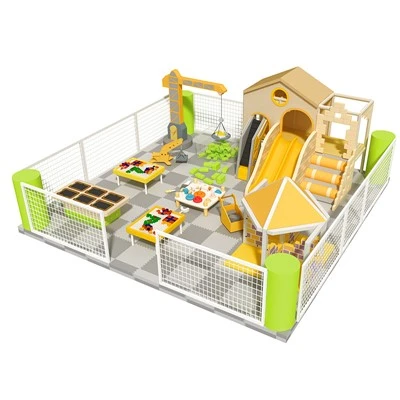
As a supplier of Soft Play Houses, I've witnessed firsthand the profound impact these engaging play spaces can have on children's development. In this blog, I'll explore how a Soft Play House can be a powerful tool in nurturing various aspects of a child's growth.
Physical Development
One of the most obvious benefits of a Soft Play House is the promotion of physical development. Inside these playhouses, children are encouraged to move, climb, crawl, and jump. For instance, a Soft Play Bridge within the playhouse provides an opportunity for children to practice their balance. As they carefully navigate across the bridge, they strengthen their core muscles and improve their proprioception, which is the sense of their body's position in space.
Climbing structures in the Soft Play House also play a crucial role. When children climb up and down the soft walls or platforms, they are building strength in their arms, legs, and back. This physical activity is essential for the development of gross motor skills. Gross motor skills involve the large muscles of the body and are necessary for activities such as running, jumping, and playing sports. Regular use of the Soft Play House helps children develop these skills at an early age, setting a solid foundation for a healthy and active lifestyle.
In addition to gross motor skills, fine motor skills are also enhanced. Many Soft Play Houses come with small interactive elements like buttons to press, zippers to zip, and strings to pull. Manipulating these small objects requires precise hand - eye coordination and the use of the small muscles in the hands and fingers. For example, a Sensory Soft Play area might have textured fabrics with hidden objects that children need to feel and extract, which further refines their fine motor skills.
Cognitive Development
Soft Play Houses are not just about physical activity; they also stimulate cognitive development. When children enter a Soft Play House, they are often presented with a new and complex environment. They need to explore, observe, and make sense of this space. This exploration process helps them develop problem - solving skills. For example, if a child wants to reach a toy on a high shelf in the playhouse, they might need to figure out how to use the available climbing structures to get to it.
Imagination and creativity are also greatly enhanced in a Soft Play House. Children can transform the playhouse into different settings, such as a castle, a spaceship, or a jungle. They can create their own stories and scenarios, which is a form of pretend play. Pretend play has been shown to be crucial for cognitive development as it helps children understand different roles, emotions, and social situations. For instance, they might pretend to be doctors treating patients in a makeshift hospital within the playhouse, learning about empathy and the concept of helping others.


Memory and spatial awareness are other cognitive areas that benefit. As children move around the Soft Play House, they need to remember where different objects are located. They also develop an understanding of spatial relationships, such as how to fit through a small tunnel or how to arrange furniture in a pretend room. This spatial awareness is important for later academic skills, such as reading maps and understanding geometry.
Social and Emotional Development
Soft Play Houses are often designed for group play, which makes them excellent for social development. When children play together in a Soft Play House, they learn important social skills such as sharing, taking turns, and cooperation. For example, if there is only one slide in the playhouse, children need to learn to wait their turn and share the slide with others. This helps them develop self - control and respect for others.
Communication skills are also improved. Children need to talk to each other to plan their pretend play scenarios, negotiate roles, and solve problems together. They learn to express their ideas clearly and listen to the opinions of their peers. This verbal communication is essential for building relationships and interacting effectively in different social settings.
On an emotional level, a Soft Play House provides a safe and supportive environment for children to express their feelings. They can act out their fears, joys, and frustrations through pretend play. For example, a child who is afraid of going to the doctor might pretend to be a doctor themselves, which can help them confront and overcome their fear in a safe and controlled way. The Soft Play House also gives children a sense of ownership and control over their environment, which can boost their self - confidence and self - esteem.
Sensory Development
The Sensory Soft Play aspect of a Soft Play House is a key factor in promoting sensory development. Soft Play Houses are often filled with a variety of textures, sounds, and colors. The soft materials used in the construction of the playhouse provide a tactile experience. Children can feel the smoothness of the fabric, the roughness of the textured panels, and the squishiness of the foam. This tactile stimulation helps them develop their sense of touch and can be particularly beneficial for children with sensory processing issues.
There are also often built - in sound elements, such as bells that ring when a button is pressed or musical instruments that can be played. These auditory experiences help children develop their sense of hearing and can enhance their musical awareness. The bright and vivid colors used in the design of the Soft Play House stimulate the visual sense. Different colors can evoke different emotions and can also help children learn about color recognition.
Educational Value
Soft Play Houses can be integrated with educational elements to make learning fun. For example, some playhouses might have alphabet or number stickers on the walls, which can help children learn basic literacy and numeracy skills. They can also be used to teach children about different cultures. For instance, a playhouse can be decorated to represent a different country, and children can learn about the customs, traditions, and geography of that place through pretend play.
Why Choose Our Soft Play Houses
As a supplier, I'm proud to offer high - quality Soft Play Houses that are designed with all these developmental benefits in mind. Our products are made from safe and durable materials, ensuring that children can play in a secure environment. We also offer a wide range of designs and configurations to meet the different needs and preferences of our customers. Whether you are looking for a small Indoor Play House for a home or a large, elaborate play structure for a daycare center or a school, we have the perfect solution for you.
If you are interested in promoting children's development through our Soft Play Houses, I encourage you to get in touch for a procurement discussion. We can work with you to select the right products, provide installation services, and offer ongoing support. Investing in a Soft Play House is an investment in the future of the children in your care, and we are here to help you make the best choice.
References
Berk, L. E. (2018). Infants, children, and adolescents. Pearson.
Hughes, C., & Devine, R. T. (2015). Social pretend play and the development of executive function: A review. Frontiers in Psychology, 6, 1128.
Lillard, A. S., Lerner, M. D., Hopkins, E. J., Dore, R. A., Smith, E. D., & Palmquist, C. M. (2013). The impact of pretend play on children's development: A review of the evidence. Psychological Bulletin, 139(1), 1-34.